Monday, February 6, 2012

A DAY OF EVOCATIVE SOUNDS


Bleating goats, crashing waves, echoing footsteps and dripping water in El Tunel, speakers blasting religious music, and the bells of all the churches sounding the hours, edging out the "Hey!" "Hey!" of the gulls, and sending me off to sleep.

AMAZING SIGHTS


Pavement that made me seasick!


A tunnel through the hill, a nineteenth century tourist attraction. It was cool to be able to stand on the seafront watching the waves crash in, though potentially fatal to dogs and small children.


The medieval streets with their XV century palacios, some restored, some going to rack and ruin.


Beautiful white beaches, and people swimming although it was breezily brisk.


The picture that got away. From one balcony, dripping with roses, a rather majestic woman, a bold white streak in her long black hair, looking like one of Goya's majas, gone to seed. I tried to get her photo by pretending to photograph the streetscape in general, but she was wise to me, so I will try to give a sense of the romance of it by using this picture by Goya.

Friday, February 3, 2012

THE STREETS OF LAREDO


Laredo was a long town stretching along a 4km sand spit, or puntal. Most of it was new holiday apartments, pretty unremarkable. My travelling companion made sure that I didn't get off in this section, but carried on to the edge of the old town. As I was getting off the bus, I noticed first the plethora of open restaurants! Food at last! I also noticed a scruffy sort of peregrino, a young guy with dark dreadlocks and the ruddy complexion which denoted lots of time spent in the open air. He had none of the usual slick accoutrements of the typical hiker, but looked more like a tramp, or one of those ruffians from the night before, than someone walking the Camino. I found myself avoiding him, and chided myself for judging by appearances.

I wandered into the old town which was, as usual, built on a big hill. As I entered a plaza lined with eighteenth century buildings, The Messiah was blasting from some huge speakers on a balcony. Talk about taking it to the streets! I climbed all the way to the top of a cobbled street to the beautiful medieval church above. It looked like church was just over, as several people were coming down the street carrying ramos, leafy branches, which symbolized the palm leaves waved at Jesus when he entered Jerusalem. I couldn't figure out why they didn't use palm leaves, since there are palm trees everywhere. We do use palm leaf crosses, and we have none. Other people carried ramos decorated with cookies, ribbons and crepe paper. One woman carried an elaborate construction of palm, like a corn dolly. The interior of the church was full of art treasures, but I just wanted to get rid of my pack, so it was down the street again to look for a place to stay.


I stopped first at the Albergue Buen Pastor and rang the bell. The woman on the other end purported not to understand a word of my Spanish, (which is really NOT that terrible) and ended the conversation. I waited for a bit and when she did not appear, decided to go elsewhere. I was offended for a second time in as many days. I decided that she was an 'inhospitalera'.

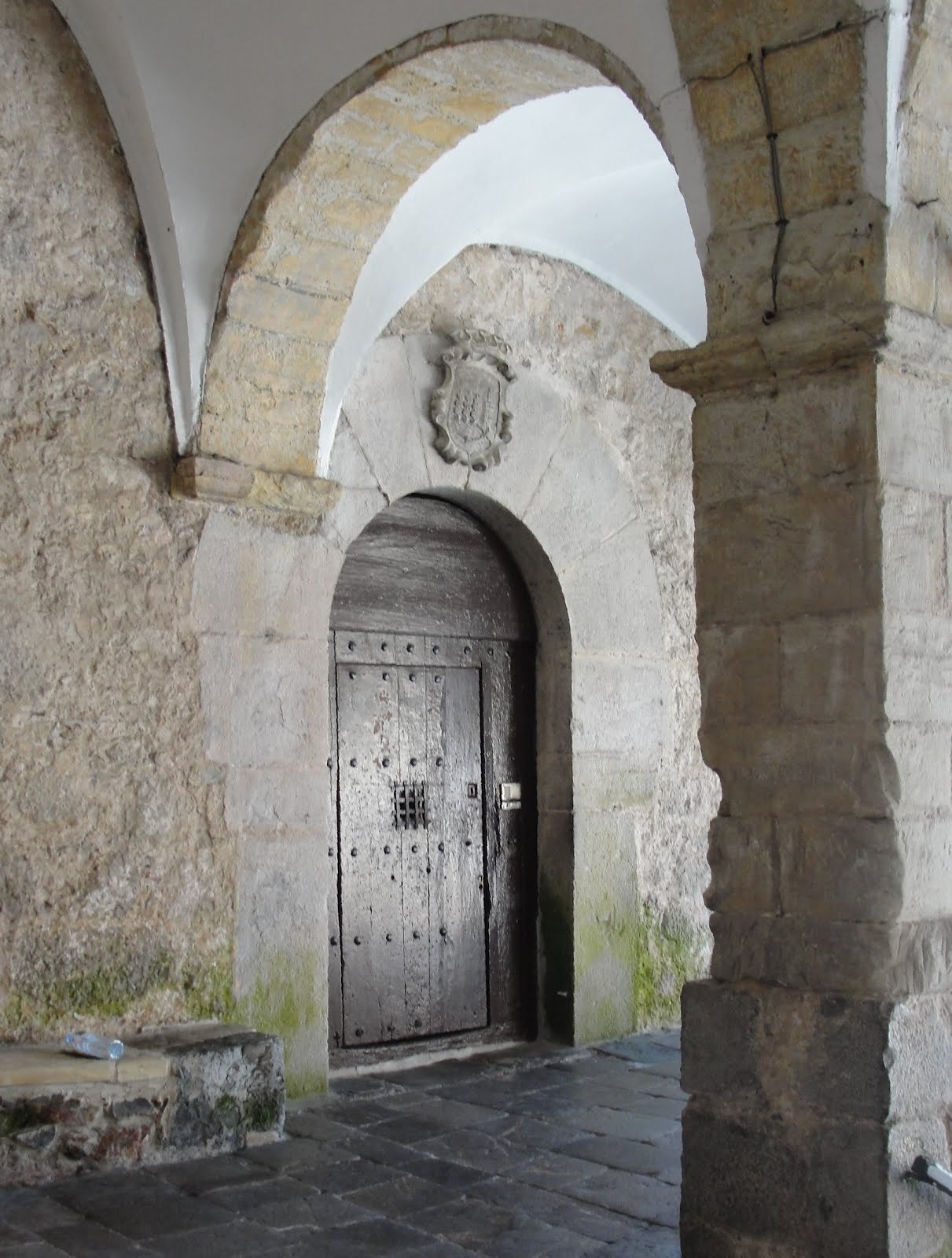
I followed the yellow arrows to the albergue located in a medieval convent, and run by the Trinitarian Mothers. Once again I went to the intercom to gain access. This time the disembodied voice directed me round to the front, where I rang the bell on a huge old wooden door with a iron grate.


A round and rosy nun welcomed me in, and took me upstairs to my own little cell. The furniture was cheap and mismatched, but everything was very clean, and I had a room of my very own! I had a window high above the street, where I could look out to the hills and see. If I wanted to, I could pretend to be the rebellious daughter of a local count, locked up to control my waywardness. Or I could hang my laundry on the clothesline across the window. Only Jesus, watching me from the picture on my wall, would know.


In all the time I was there, I only saw this one nun. The others were cloistered. I took a peek between the doors leading to the cloister, whose green plaster walls were overflowing with art, presumably done by the nuns. I would have loved to be able to see all the expressions of their creativity, but it was not to be.


After a shower, laundering my socks and underwear, and a snack from my pack, I was ready to see some more of the town.

Thursday, February 2, 2012

IN WHICH I RESCUE A GOAT; AND TAKE YET ANOTHER BUS


As I set off from the powerless albergue the next day, the sun was just rising over the Cantabrian Sea, gilding the ugliness of the town, transforming it into something splendid. I soon met up with Dutch Patti. After no shower and no means of making coffee or brushing our teeth, we were eager to get to the next village and get some sustenance. We passed though Allendelagua, which turned out to be nothing more than a suburb of Castro Urdiales; very pretty but with no amenities. Cerdigo was no better, despite being right alongside the main road. Dutch Patti was a younger faster walker, so I suggested she go ahead.
From Cerdigo, the Camino took a turn by a small rose-bedecked cemetery and entered some lovely woods, complete with a pony. We were in another limestone area, and the trail was strewn with boulders. I could see the ocean glinting in the distance, and was thrilled to come out on some cliffs. I enjoyed the walk through pastures in the fresh sea breeze. The contrast between these wonderful sections and the scary pavement made it harder to take the bad with the good.

Pretty soon I came upon Patti, sitting at the base of a small lighthouse, having a snack. I decided that since there was obviously no coffee in the offing, I would do the same. We chatted for a while about our lives; she was a university teacher; she’d wanted her boyfriend to come with her, but he thought it was more of a thing for retirees to do, so she had come on her own. Next time, she said, she was bringing her bike! Walking was just insufficiently efficient!

We said our goodbyes, while I lingered a while, airing out my socks and enjoying the sun. Islares was only a couple more kilometers away, and I was pretty sure I wasn’t going to walk any more that day, since it was a choice between highway for nine kilometers after Islares, or a high mountainous route with no albergues for another 23 km. I didn’t like the sound of either one, so I decided, once again, to become a “busagrino”.

Still, I had to get to Islares. Maybe they had coffee there? So it was back to the pasture. There was a herd of goats making a terrible fuss. I soon saw why. A young male, half grown, had got his head stuck in the page wire fence, as he attempted to get at some delectable greens on the other side. I watched him for a while to see if he could figure out how to get free, and it was soon evident that he was well and truly stuck.


There was no way he could reconnoitre the fence wire, his recurved horns caught on it every time. I could either leave him alone, to the mercy of the sun and his own panic; or I could try to free him. I ditched my pack and my camera, and got down on my knees next to him. Well, didn’t he squeal as soon as I touched him? I looked around for his mother, a black goat who had been standinng guard over him, expecting that she might posssibly have a go at me, but she was standing in that awful state that ever parent has known at one time or another, that of “watchful waiting”, not knowing what the outcome would be, but knowing that one’s place is at your child’s side.

The little guy put up quite a fight, and I realized I was going to have to wrangle him. I flipped him on his side and tried to twist his neck sideways to get his head out. He was incredibly strong, just solid muscle, but eventually we got the job done. As soon as he was free, he stopped squawking, and levitated halfway cross the field to his mother’s side. I swear her devil eyes thanked me, but he wanted nothing more to do with me. I had a nice big bruise from one of his horns on my forearm for my pain, but I also had a nice warm glow. I’d done my good deed for the day. Surely Santiago Peregrino, or whoever was the patron saint of goats and goatherds would forgive me for the bus I was about to take.

Islares was also shut up tight as a drum so I headed for the bus shelter to wait for the bus that might or might not be coming to take me to Laredo. I’d forgotten it was Palm Sunday! But I had faith that sooner or later I’d be in luck, or at least find out what was what. Soon I was having a nice conversation with an older man who was also headed to Laredo for his daily constitutional, up and down the four mile beach. Gosh, it must be nice, I thought to have these kinds of opportunities at one’s doorstep. For a mere 3 euros one could have a 15 km bus ride and a day at the beach. My Euro-envy was kicking in like crazy! I told him that I was taking the bus because I was afraid of walking on the highway, and he supported my decision 100%. He told me that this section was “muy peligroso”, very dangerous, and that I shouldn’t consider it!

As the bus pulled up the first hill, we passed within inches of Dutch Patti, wedged in the tiny gap between the road surface and the cliff. There was literally NO shoulder. We proceeded along with hairpin bends, fast cars and logging trucks. I didn’t find myself moved to prayer that often, but I prayed that she would make it safely to the town. Later, I talked to several peregrinos who had found the going not too bad, but I wasn’t convinced.

THINGS GO DOWNHILL


It was siesta time in Onton, and nothing moved. What looked like a bar, with a couple of umbrellas advertising beer on the back deck might have just been someone’s house. It might as well have been, anyway. I asked the lone humans I met, a man and his little girl, for directions to the bus stop, which was across from the ancient church, set into the peculiar sugar loaf hill. The stop was in front of a group of bedraggled row houses, which looked pretty empty. I sat on a cement capped wall and hunkered down to wait. Pretty soon the sun came round and started beating on me. I watched the cars zoom by on the road, and on the main road above the village. There were lots of sporty motorcycles whizzing along, and I saw one car/bike encounter which surely would have resulted in a fatality, had it not been for the fast reflexes of the motorcyclist.

Only one group of pilgrims came along, a family group, which included the pilgrim I’d followed up the escalator in the morning. They wondered why I was sitting there, and I told them that I was afraid to walk on the road. They just shrugged, probably amazed at my timidity, and wished me a Buen Camino, as they headed up to the highway.

I knew the bus must be coming soon, as a couple of housewives emerged from one of the ( not so empty after all) houses, and made their fond goodbyes, with many tears and hugs. The chubbier of the two, with jet black old fashioned permed hair, and dressed in a printed house dress, a cardigan and slippers, hoisted herself onto the bus after me. I sat on the floor to stabilize my pack, and she sat in the seat above me. At first we were having a jolly old chat. She asked me lots of questions about where I was from. Did I have a family? How old were my children? Why did I come on a second camino? And then to my utter shock, she let fly ! I was on a DEMONIACAL way! SHE would NEVER leave her children. I must be a TERRIBLE woman to do do this. I tried to defend myself politely, saying what a ‘buen hombre’ my husband was to afford me this kind of freedom from the traditional wife’s role; trying to fit what I was doing into a framework that didn’t cause her to go into an eye-rolling, spittle-flinging frenzy of hate. And then I just gave up and watched the scenery go by. I suppose I should have understood that she might be disapproving, given her traditional appearance, but I certainly didn’t expect a haranguing. Never mind that at this particular point in the journey, I would have just as happily been at home making Kraft Dinner for Alex, I was OFFENDED! Cantabria was not off to a good start.


I asked the bus driver if the bus went anywhere near the albergue de peregrinos, and he assured me that it was quite close by; “detras (behind) de la plaza de toros”. As I watched the newer parts of Castro Urdiales slide by, my knees were glad that I hadn’t walked on all those sidewalks. The last 4km were in the town, which has got to be the worst seaside town I’ve ever seen: ranks and ranks of modern highrise holiday apartments, completely blotting out the view of the sea. I could kick myself now that I didn’t expend the energy to go back and see the old town, which had been one of the things I didn’t want to miss, but the rest of the evening was pretty chaotic, and I just didn’t get there. Another time, perhaps?


The bus driver wasn’t kidding. The albergue was directly on the bus route, since the plaza de toros was also the bus terminal. The place was less than inspiring. When I arrived, the door was wide open and there was no sign of the hospitalero. Inside, I found the Spanish family of earlier, who had obviously survived the highway, a Dutch woman with a bad sunburn, who was the doppelganger of my boss at work, right down to her mannerisms. In my mind, I dubbed her “Dutch Patti”. There was a young Spanish couple, dedicated to snogging, and a couple of American boys on a break from Deusto University in Bilbao. When I got there, they were napping, having walked some incredible distance, but soon they were up, playing cards.

Patti let me know that the food choices were limited to a shop down among the apartment buildings or a four km walk back to town. I chose the path of least resistance and bought myself some very expensive bread and cheese. When I got back there were a couple of weatherbeaten guys sitting outside the albergue, looking shifty. They asked a lot of questions about staying there which peregrinos ought to know the answers to. Both Patti and I felt very uncomfortable and couldn’t wait for the hospitalero to return to sort things out. One of the men was quite sick, with a persistent cough that seemed to come from the very depths of his being. I hoped it wasn’t TB or something horrid like that, since the hospitalero never did return, and those two guys just grabbed a couple of bunks. With nothing else to do but hang around in the dark, I took a paracetamol for my knees, wrapped my scarf around my face in an attempt to prevent whatever germs were going around from getting into me, and went to bed, to the sound of hacking. It was pretty grim.

In the morning, I stamped my own credencial! I was pretty glad to put the whole of the previous day behind me. Later, when talking with some other Spanish pilgrims about Castro Urdiales, they called it “un desastre”. I concur!

Wednesday, February 1, 2012

BACK ON THE ROAD

Leaving the Pais Vasco for Cantabria


I checked out of the hotel early, and headed to “my” coffee shop for breakfast. Having said my goodbyes once, I didn’t want a reprise. From there, I walked to the underground station. I’ve never liked walking through the suburbs, and I’d heard quite a bit about the slums on the west side of Bilbao, and had no desire to walk alone through them for 19 + kilometres. I needed a bit of help to figure out how the ticket machine worked, but eventually, I got on the right train and was in Portugalete, the end of that day’s stage, in about 27 minutes. AMAZING! The few glimpses I got of my surroundings when the train reached blue skies told me I’d done the right thing.

I walked down from the train station, down, down, down, into the old town by the harbour. Portugalete tends to get a bad name in some of the tourist stuff you read, but I found it charming, from its boldly painted buildings, to its tiny winding alleys, to the market setting up in a plaza along the river bank.


I walked up and up to the ancient church and the Torre de Salazar, where I got an excellent view of the transporter bridge, the Puente Colgante, which is Portugalete’s main claim to fame these days. Cars, railway cars, and people are taken across the river Nervion from Getxo to Portugalete in under a minute. It’s a World Heritage Site, but it reminds me of a giant version of the archaic tramway at Dominion Bridge in the Sault, which used to terrify me every time it started rolling when I was a little kid playing in the front yard of my Grandma’s house.

From the church it was another exceptionally steep climb to get back up into the modern town to find the Camino once again. I was pleasantly surprised to discover a moving staircase going up. I got behind another pilgrim and followed him to the top of the hill (erm...cliff). There I stopped for an orange juice, though I hadn’t really done any work at all so far. The camino path was well signed with brass scallop shells embedded in the sidewalk. As I walked through the business district of the town, which was just waking up for the day, I came across a truly ancient couple, dressed rather formally in the way of nonogenarian Spaniards, helping one another into a shop. It brought tears to my eyes to see their love for one another shown in this physical way.


As I left the town on a bike path with a rubberized surface, I was astounded to see that it crossed a superhighway corridor on a skyway! That was something the pilgrims of old never contemplated; nor superhighways neither! I followed that bikepath all the way to La Arena, a beach town on the banks of the Rio Barbadun, which formed the border with the province of Cantabria. I hated to say “Agur” to the Basque country, where I felt very comfortable. But it was time for a new part of the adventure.

In La Arena, I had a coke in a very dirty restaurant, and nothing in the “cafeteria” across the street. It didn’t sell food, just coffee etc. I aired out my feet which were extremely hot after nearly 14 km on pavement and ate the apple which was the only food I had. Luckily, I came across an ice cream truck on the beach, and enjoyed a sugar cone of chocolate ice cream before moving on. I figured I’d get some food in Onton, in another six kilometres.

I crossed the river on a wooden footbridge and climbed the cliff opposite on a set of stairs. I met lots of people out for a weekend stroll, and one young woman, seeing my pack, wished me Buen Camino and asked if I wanted to stay at her house in Santander! Really, the hospitality is quite extraordinary.
The next section, which hugged the cliffs along the sea coast, was almost worth the many kilometres of pavement from the morning. The sea and sky were blue, the sun was warm and everywhere you looked was beautiful.


The path, built on the bed of an old narrow gauge railway took me past the ruins of various defensive structures, and past spots where in the olden days, people rappelled down the cliffs to harvest shellfish and seaweed.


The cattle looked fat and happy as they gazed out at the sea, chewing their cuds and watching the world go by. I got to Onton quite quickly.


I rested a bit on a bench below a bridge before making the somewhat treacherous descent to the town, and as I did, I saw a bus go by. Drat! I hoped it wasn’t the last one of the day. My knees were killing me, and I knew that after Onton, the Camino followed the N-634, a pretty major road. There was an alternative inland route, but that was fifteen kilometres more. In retrospect, that might have been the better idea, but I couldn’t know that I’d have to wait three hours for the next bus, and that there was no food in Onton, nor any drink, nor anything much at all.

Sunday, January 29, 2012

HELLO AND GOODBYE


After finally getting to the Cathedral to get my sello from the hands of a smiling YOUNG nun, I headed back to my "neighbourhood" to "my" bar, where I'd had numerous coffees and breakfast, and where the proprietor and his wife were starting to recognize me. I would be leaving the Basque country tomorrow, and so I thought I'd better try some txakoli, the resinous white wine grown on Basque hillsides. It was sour and acrid, not to my taste at all, but the day got sweeter, as I caught a glimpse of "my" peregrinos heading down the street. I rushed out, signifying to the owner that I'd be right back, and wasn't running out on my debt. (In Spain you never pay for your drinks until you are ready to leave). I told them about the hotel and they went off to see if there was any space. I went back and finished my drink.

Ana and Margi were able to get a room, but there was only one. Gisbert and the Vikings were out of luck, but had lots of leads on other places. Gisbert asked if he could bunk down in my double, but I told him I didn't think that my husband would likely be impressed. I know he was offended, being an honorable person, but proper is proper. He had been sleeping on the floor in various lady's rooms all week, but there was always more than one lady! So he followed Liv and Anna Maria off on the search for a room.

We agreed to meet up at the local sidreria for a farewell meal. Ana and Margi were finished their camino, and Gisbert and the two ladies were going to be on a different schedule than me from now on. Later, Margi, Ana and I went for a constitutional along the river walk, where we saw a run/march in support of the Basque language and watched rowers train on the river. The cool air and the warm golden sun falling on our faces was so pleasant, it was hard to leave, but it was getting late. Time to eat!


The streets of the old town were full of the runners and other merry makers. The bars were spilling people into the street, banners were flying and there was an air of general happiness and good will.


As we walked toward the restaurant, I spotted my friend, Miguel de Murcia, sitting at a table. Big bear hugs ensued. I learned that Miguel had messed up his ankle on the day after Gernika, and like me, had been chilling in Bilbao waiting to be better. We didn't meet again on the Camino, but later, in looking at Gisbert's online photos, I saw him again, hale and hearty, and was glad to see he'd made it back onto the road.

In the sidreria, there was much hilarity, as we learned the proper way to tap a keg of sidra. As long as you order the table de hote, you can have as much sidra as you like, provided you amble over the sticky floor to pull your own. You don't fill your glass, so you need to make several trips. A clever way of self-limiting your consumption.


The meal was HUGE! Three courses, each of which would be enough. I had morcilla, blood sausage, in a tomato sauce, an omelette with asparagus, and some fish. And after that, we had postre, dessert, which was pastel aux Basques,an apple-y cake. And then it was time for bed. I left early the next morning, replete with addresses, and sad to know that this part of the journey was over.